By Marissa Ferrari, Creative Director
Corporations spend tens of thousands of dollars to research prospective customers and build what are called “customer personas.” As a researcher myself, I always advise mission-driven organizations to directly engage with your stakeholders to understand what they need and want from your organization.
But if you don’t have the time or resources to undertake extensive research, you can start somewhere – by using your team’s existing knowledge to sketch an audience persona.
Why would you do this? Understanding your stakeholders can help inform your day-to-day thinking and long-range planning – and make better decisions about how you connect with the people who make your mission possible.
Often, however, knowledge of stakeholders is concentrated and bottlenecked – there may be a couple of individuals on your team who truly understand major donors, for example, and why they give to your organization. But what happens when those folks move on? Or just happen to be on vacation?
Building an audience persona for each of your top three stakeholder groups is an excellent way to get that knowledge out of people’s heads and get it down on paper – so every member of your team can ace their next meeting, email, appeal, or event.
Here’s how to do it.
Step 1: Prioritize Audiences – Less is More
In this step, you’re going to consider all of the stakeholder groups – think funders, volunteers, partner organizations, etc. – that support your mission and narrow down to the 3 that are most important to your work at this time.
The relative importance of each group could be driven by:
Your current strategic plan priorities;
Your marketing and communications goals; or
A specific campaign such as a capital campaign.
The most important consideration is starting small: practice with 3 groups, and give yourself a chance to experiment with and learn from this technique.
You can always repeat the exercise with additional audiences later.
Step 2: Make a Sketch
This step is about knowledge transfer – getting everything that is known about a given audience out of team members’ heads, and onto paper so that every member of your team is working from the same knowledge base.
Start by gathering your entire team, or at minimum everyone who has some first-hand knowledge of your top 3 stakeholder groups.
Going one audience at a time, each of you will take a few minutes to picture an actual member of the stakeholder group you are considering. A real person with a name, face, picture, and characteristics.
Then, on a flip chart, you’ll start to sketch a “portrait” of that audience member.
Write down everything anyone can think of:
- Who is this person? Age, position, character traits, etc.
- What are their current behaviors? Job, family, interests, spending, etc.
- What are they trying to accomplish? Professional and personal goals, motivations, unspoken intentions
- What are their challenges? Obstacles, especially to motivations and intentions
Of course, you won’t know everything about every member of your target audiences.
Perfection is not the point; getting what you do know out of people’s heads and down on paper is the goal.
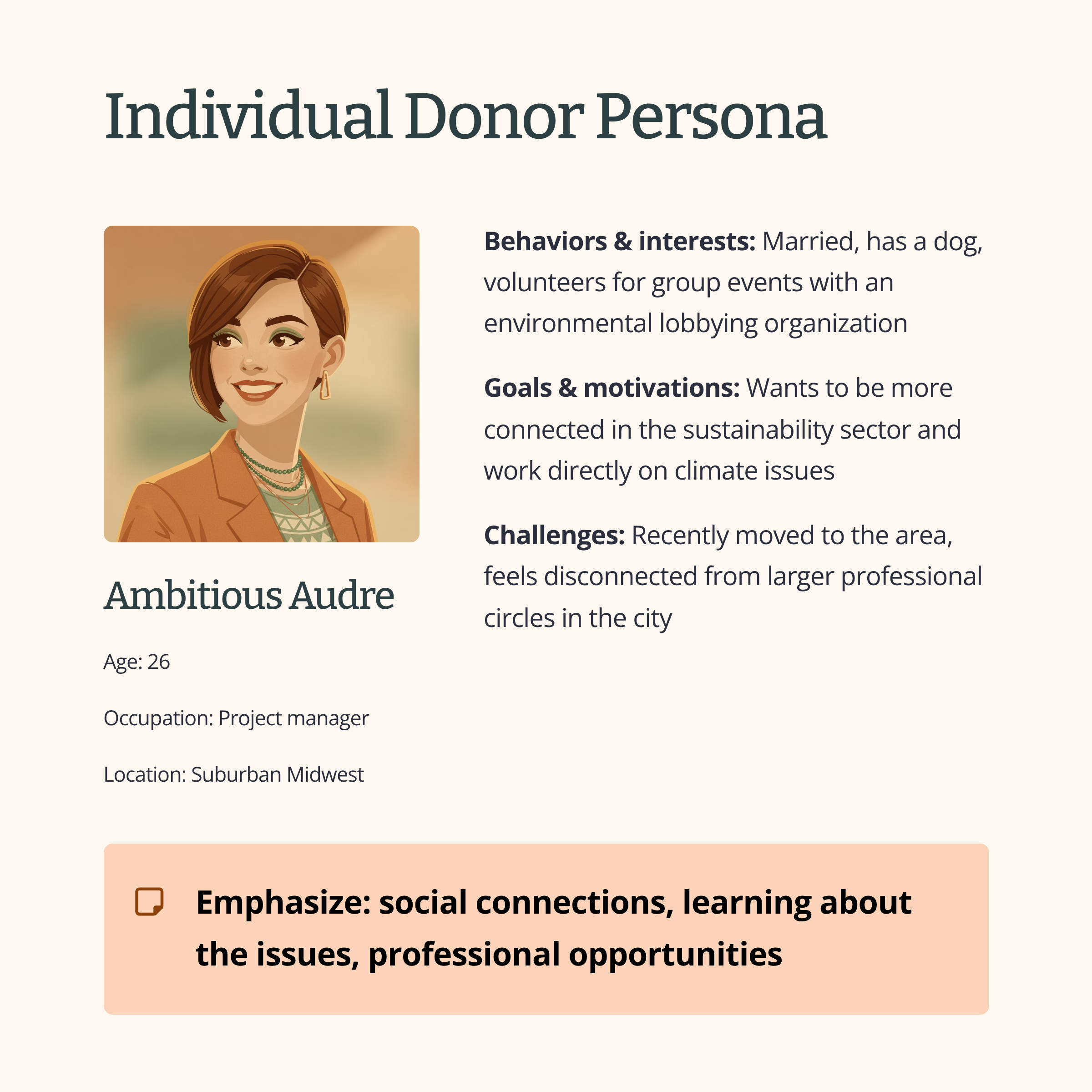
Let’s imagine that we’re developing a persona for an individual donor. Our persona sketch might look something like this:
| Audre, 26
Married, has a dog, no children |
Project manager,
lives in the suburbs, volunteers for group events with an environmental lobbying group |
Wants to be
more connected in the sustainability sector and work directly on climate issues |
Recently moved
to the area, disconnected from larger professional circles in the city |
|---|
Step 3: Capture and Share
Now that you’ve developed a simple persona (or 3), document and share it with everyone on your team. Put it in your planner, on your cubicle, or next to your phone.
The point is, make it visible and make it a touchstone – so you make use of it. Remind yourself of these motivations when you’re preparing for a meeting, writing an email, picking up the phone, etc. etc.
If you’re feeling overwhelmed, remember: DIY audience definitions are better than no definitions at all — and, no matter what, your team will learn from one another as you download and capture the wealth of knowledge in your heads.
And if you want support designing or facilitating a more in-depth research process, just hit reply. We’d love to help.
BONUS Step 4: Write Your “Job Description”
Once you’ve started to integrate audience personas into your day-to-day thinking, you can use them as a tool for more strategic planning.
One way to shift our thinking to mirror our audiences’ perspectives is to ask ourselves what “job” they are “hiring” us to do. In other words, how are we helping to address what’s important to them – whether it’s stated directly in our mission or not?
In a “jobs to be done” framework, instead of starting with our goals, we start with the audience and the outcomes they seek.
Let’s return to the example of the individual donor. Knowing that Audre needs to feel a sense of belonging and advance her career prospects, you might incorporate some tactics that speak to those underlying motivations into your long-range planning.
Convince her friends to care —–> Online giving features to gently pressure her peers to donate, i.e. “Donate on behalf of your friends”
Continue learning about the issue —–> Email sign-up and drip campaign to continue and nurture the relationship
Mingle with like-minded people —–> Happy hour event with tabling by volunteer organizations with climate change focus
Build her base of contacts —–> Young professionals group with climate change focus